
-
 Argentina
-
 Australia
-
 Austria
-
 Belgium
-
 Brazil
-
 Canada
-
 China
China
-
 Czech Republic
-
 Denmark
-
 Finland
-
 France
-
 Germany
-
 Greece
-
 Hong Kong
-
 Hungary
-
 Iceland
-
 India
India
-
 Ireland
-
 Israel
-
 Italy
Italy
-
 Japan
Japan
-
 Korea
Korea
-
 Luxembourg
-
 Malaysia
-
 Netherlands
-
 New Zealand
-
 Norway
-
 Poland
-
 Qatar
Qatar
-
 Romania
-
 Saudi Arabia
-
 Singapore
-
 Spain
Spain
-
 Sweden
-
 Switzerland
-
 Taiwan
-
 Turkey
-
 United Kingdom
-
 United States
research use only
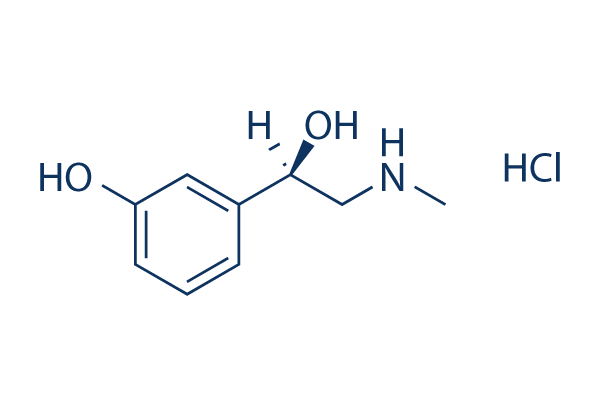
Phenylephrine HCl Adrenergic Receptor agonist
Cat.No.S2569
Quality Control
| Related Targets | CXCR Hedgehog/Smoothened PKA AChR 5-HT Receptor Histamine Receptor Dopamine Receptor Ras KRas GPR |
|---|---|
| Other Adrenergic Receptor Inhibitors | ICI 118551 Hydrochloride (Zenidolol) L755507 Yohimbine HCl Atipamezole Higenamine hydrochloride Noradrenaline bitartrate monohydrate Fenoterol hydrobromide Medetomidine HCl Isoprenaline L-Adrenaline |
Solubility
|
In vitro |
DMSO
: 41 mg/mL
(201.3 mM)
Water : 41 mg/mL Ethanol : 41 mg/mL |
Molarity Calculator
|
In vivo |
|||||
In vivo Formulation Calculator (Clear solution)
Step 1: Enter information below (Recommended: An additional animal making an allowance for loss during the experiment)
Step 2: Enter the in vivo formulation (This is only the calculator, not formulation. Please contact us first if there is no in vivo formulation at the solubility Section.)
Calculation results:
Working concentration: mg/ml;
Method for preparing DMSO master liquid: mg drug pre-dissolved in μL DMSO ( Master liquid concentration mg/mL, Please contact us first if the concentration exceeds the DMSO solubility of the batch of drug. )
Method for preparing in vivo formulation: Take μL DMSO master liquid, next addμL PEG300, mix and clarify, next addμL Tween 80, mix and clarify, next add μL ddH2O, mix and clarify.
Method for preparing in vivo formulation: Take μL DMSO master liquid, next add μL Corn oil, mix and clarify.
Note: 1. Please make sure the liquid is clear before adding the next solvent.
2. Be sure to add the solvent(s) in order. You must ensure that the solution obtained, in the previous addition, is a clear solution before proceeding to add the next solvent. Physical methods such
as vortex, ultrasound or hot water bath can be used to aid dissolving.
Chemical Information, Storage & Stability
| Molecular Weight | 203.67 | Formula | C9H13NO2.HCl |
Storage (From the date of receipt) | |
|---|---|---|---|---|---|
| CAS No. | 61-76-7 | Download SDF | Storage of Stock Solutions | Solutions are unstable. Prepare fresh or purchase small, pre-packaged sizes. Repackage upon receipt. | |
| Synonyms | NCI-C55641 HCl,(R)-(-)-Phenylephrine hydrochloride, L-Phenylephrine hydrochloride | SMILES | CNCC(C1=CC(=CC=C1)O)O.Cl | ||
Read more about storage stability CAS number SMILES
Mechanism of Action
| Targets/IC50/Ki |
α1-adrenergic receptor
|
|---|---|
| In vitro |
Phenylephrine causes a rapid translocation of PKC-epsilon (EC50 = 0.9 mM) but the proportion lost from the soluble fraction is less than with ET-1. Phenylephrine at pCa 7 causes a dose-dependent increase in contractile force of the hyperpermeable cells, which is reversible on addition of phentolamine. Phenylephrine also protects cardiomyocytes against subsequent 24 h treatment with hypoxia and serum deprivation. Phenylephrine prevents the down-regulation of Bcl-2 and Bcl-X mRNA/protein and induces hypertrophic growth. Phenylephrine-mediated protection is abrogated by the phosphatidylinositol 3-kinase (PI 3-kinase) inhibitor wortmannin and is mimicked by the caspase-9 peptidic inhibitor LEHD-fmk. Phenylephrine stimulates phosphoinositide (PI) hydrolysis, cell growth, and expression of several genes [e.g., atrial natriuretic factor (ANF)] often associated with cardiac hypertrophy. Phenylephrine (1 礛) markedly potentiates HGF-induced hepatocyte DNA synthesis and proliferation. Phenylephrine (10 mM) reversibly increases I(Ca,L) (51.3%; n = 40) and shifted peak I(Ca,L) activation voltage by -10 mV. Phenylephrine also increases local, subsarcolemmal SR Ca2+ release via IP3-dependent signaling. Phenylephrin-induced NOi release requires stimulation of both PI-3K/Akt and IP3-dependent Ca2+ signaling. Phenylephrine-induced NOi release is inhibited by each of 1 mM prazocin, 10 mM L-NIO, 10 mM W-7, 10 mM LY294002, 2 mM H-89, 10 mM ryanodine, 5 mM thapsigargin, 2 mM 2-APB or 10 mM xestospongin C. |
References |
|
Clinical Trial Information
(data from https://clinicaltrials.gov, updated on 2026-02-13)
| NCT Number | Recruitment | Conditions | Sponsor/Collaborators | Start Date | Phases |
|---|---|---|---|---|---|
| NCT06677970 | RECRUITING | Acute Ischemic Stroke |
Yonsei University |
2024-10-01 | PHASE3 |
| NCT06802224 | RECRUITING | Anesthesia; Surgery With General Anesthesia; Noncardiac Surgery; Hypotension During Surgery; Acute Kidney Injury (AKI); Myocardial Injury After Noncardiac Surgery (MINS); Vasopressor |
University of California, San Francisco |
2025-04-01 | PHASE4 |
| NCT01731444 | RECRUITING | Blood Loss, Surgical |
University of Manitoba |
2014-12-01 | PHASE1 |
| NCT07796282 | NOT_YET_RECRUITING | Spine Surgery; Intraoperative Hypotension; Tissue Perfusion |
Mayo Clinic |
2026-09 | PHASE4 |
| NCT06083948 | RECRUITING | Hypotension |
University of Aarhus |
2023-12-20 | PHASE2; PHASE3 |
| NCT05997732 | RECRUITING | Vasoconstriction; Vasodilation |
University of Alberta |
2023-10-31 | PHASE4 |
Read more about Clinical Trials
Tech Support
Tel: +1-832-582-8158 Ext:3
If you have any other enquiries, please leave a message.
Signaling Pathway Map

Products are for research use only. Not for human use. We do not sell to patients.
©Copyright 2013 Selleck Chemicals. All Rights Reserved.